You are here
Curricular Structure
The Study Plan of the Master’s Program in Industrial Engineering (Exempt Resolution No. 1290, dated April 28, 2020, Exempt Resolution No. 7620, dated August 12, 2022, Exempt Resolution No. 535, dated January 18, 2024) has a nominal duration of three semesters, is offered in a blended-learning format, during the evening, and requires a total workload equivalent to 60 SCT-Chile credits and 44 TEL credits. The Study Plan includes core courses, elective courses, and a Graduation Project component, aimed at training specialists in Industrial Engineering with an emphasis on Operations Management and Innovation Management.
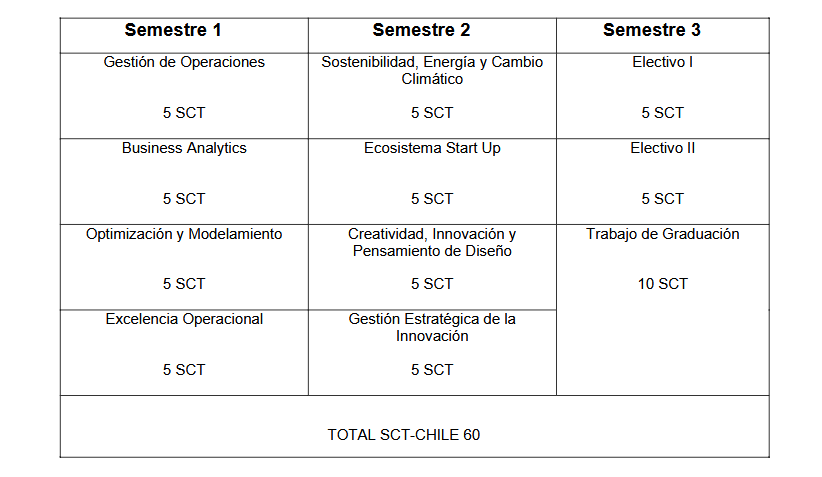
- During the first semester, students undertake training in Operations Management, focused on developing competencies in operations management, data analysis, optimization, modeling, and operational excellence. Upon successfully completing the corresponding courses, students may obtain the Diploma in Operations Management.
- During the second semester, students deepen their training in Innovation Management, incorporating content related to sustainability, energy and climate change, entrepreneurial ecosystems, creativity, innovation, design thinking, and strategic innovation management. Upon successfully completing the corresponding courses, students may obtain the Diploma in Innovation Management.
- During the third semester, students follow a flexible learning pathway through two elective courses and undertake their Graduation Project, in which they apply the knowledge and skills acquired throughout the Program by completing a final project under one of four modalities: Master’s Thesis, Supervised Internship, Graduation Seminar, or Portfolio.
Students may request the transfer of credits for courses completed at other higher education institutions or the recognition of courses completed at the University. In such cases, the Program requires students to complete a minimum of 50 SCT-Chile credits within the Program.
The student’s expected curricular pathway is presented in the diagram below: